.jpg)
What actually makes something a centipede
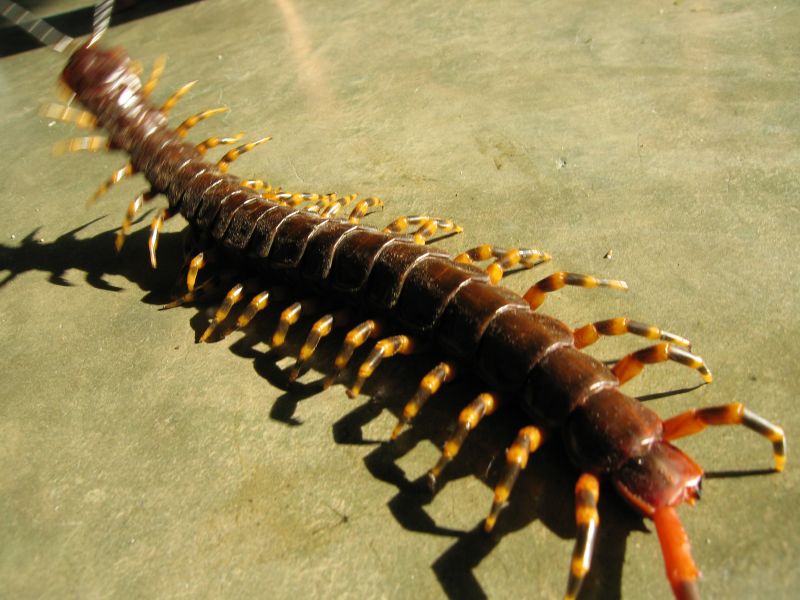
"Centipede" literally means "hundred feet," but no centipede species has ever been found with exactly 100 legs. The class Chilopoda, part of the larger group Myriapoda that also includes millipedes, comprises roughly 3,300 described species split across five living orders, according to the taxonomic overview on Wikipedia's Chilopoda entry, sourced to standard invertebrate zoology references. Each body segment carries a single pair of jointed walking legs, and the very first pair, just behind the head, is modified into a set of venom claws called forcipules, built for gripping and injecting prey, not walking.
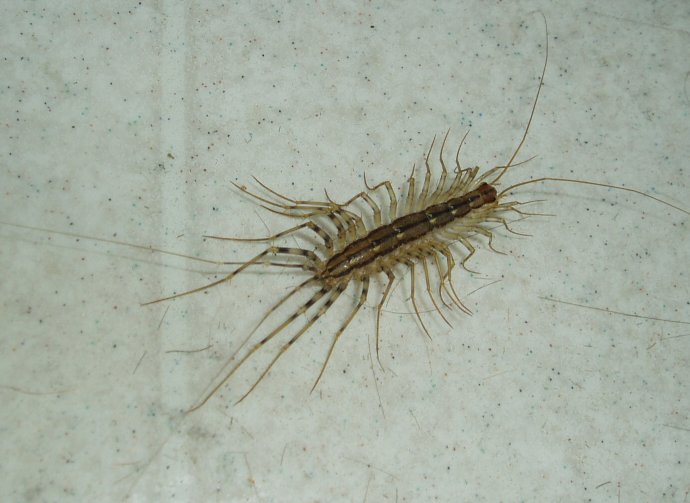
Leg count varies enormously between species, from as few as 15 pairs to as many as 191, depending on the order. Scutigeromorpha, the order that includes the common house centipede, has a domed head with large compound eyes and only 15 pairs of long legs built for speed. Geophilomorpha, the thread-like soil-dwelling centipedes, can carry more than 90 pairs on a body built for pushing through narrow spaces underground rather than for running.
The one rule every species follows, and why
Across every order, every one of those roughly 3,300 species shares a single unbroken pattern: the total number of leg-bearing segments is always odd. Nobody has ever documented an exception. In 2004, Ariel Chipman, Wallace Arthur and Michael Akam set out to explain why, working with Strigamia maritima, a coastal geophilomorph centipede, in a study published in Current Biology. Tracking the expression of two marker genes during embryonic development, an odd-skipped-related gene and a caudal homolog, they found that new segments are laid down two at a time in the growing embryo, a double-segment periodicity, before that pairing resolves into the single segments that each grow one pair of legs.
That developmental mechanism has a direct consequence for what evolution can and can't do to a centipede's body plan. If segments are always added or removed in pairs during development, a lineage can't simply evolve one extra leg-bearing segment; it has to change by two at a time. The trunk also includes non-leg-bearing segments, including the one carrying the forcipules, which the same double-segment system generates, so the odd-legs-only rule is a side effect of the embryo's patterning logic rather than a functional requirement for locomotion. Counting a centipede's leg pairs is a simple, five-second check anyone can do, and it happens to expose a genetic constraint that took molecular biologists decades to find.
A fossil record older than trees
The oldest fossil confidently attributed to a centipede belongs to the genus Crussolum, described from isolated legs and cuticle fragments found at Ludford Lane in Herefordshire, England. William Shear, Andrew Jeram and Paul Selden formally described the material in a 1998 American Museum Novitates paper, dating it to the Late Silurian, roughly 420 million years ago, and placed it close to Scutigeromorpha, the same order as today's fast-running house centipedes. Related Crussolum material has since turned up in Devonian rocks in Scotland and New York state, suggesting the same basic leg construction persisted largely unchanged for tens of millions of years after the Silurian specimens.
Put in perspective, 420 million years predates the first dinosaurs, which the fossil record places at roughly 230 million years ago, by nearly 190 million years, and predates the earliest known forests, which the fossil record places in the Devonian around 385 million years ago. Centipedes were already walking on land using a leg design recognizably similar to a modern house centipede's before trees existed to walk under.
The giant that hangs from cave ceilings to eat bats
Most centipedes eat insects and other small invertebrates, but the Amazonian giant centipede, Scolopendra gigantea, routinely takes much larger prey. It can grow past 30 centimeters in length, and in Cueva del Guano, a limestone cave on Venezuela's Paraguaná Peninsula that hosts large bat colonies, researchers led by Jesús Molinari documented something unusual: a Scolopendra gigantea hanging from the cave's ceiling nearly two meters above the ground, anchored by only its last five pairs of legs, actively holding and eating an adult bat. The observations, published in 2005 in the Caribbean Journal of Science, recorded predation on three separate bat species roosting in the cave.
The behavior stands out for two reasons the researchers highlighted: the centipede climbs up to where flying, roosting prey actually gathers, without waiting around on the ground for something to wander past, and it overpowers animals substantially heavier than itself. It's an extreme version of the same basic toolkit every centipede carries, forcipules that grip and inject venom, scaled up to prey most invertebrate predators never attempt.

Is a sting actually dangerous?
Centipedes deliver venom with forcipules, the modified front legs described above. Poison Control's clinical summary on centipede stings currently prefers the term bite, while explaining that these appendages work differently from jaws. Its guidance describes house centipedes as relatively harmless and says most bites cause symptoms at the contact site. Scolopendra species, including the giant desert and Amazonian giant centipedes, can cause burning pain extending along a limb and lasting from hours to several days, with redness, swelling or bruising. Allergic reactions can occur; deaths are very rare and have mainly been reported in tropical areas outside the United States. The page advises seeking medical attention for infection or signs of allergy, such as throat swelling or difficulty breathing.
There's also a practical reason not to reflexively kill a house centipede on sight indoors. Poison Control's own summary notes that "centipedes are considered beneficial because they help control household pests such as cockroaches, silverfish, and ants," preying on them with the same forcipules described above. A resident population doing that job quietly is, in a narrow sense, doing pest control for free. A similar gap between reputation and evidence appears with camel spiders, whose anatomy provides no venom-delivery mechanism, and wolf spiders, whose 45 confirmed bites produced no necrosis, both covered in FactCrumbs' source-linked review of animal reputations.