
An inscription that promised 'forever,' and came close
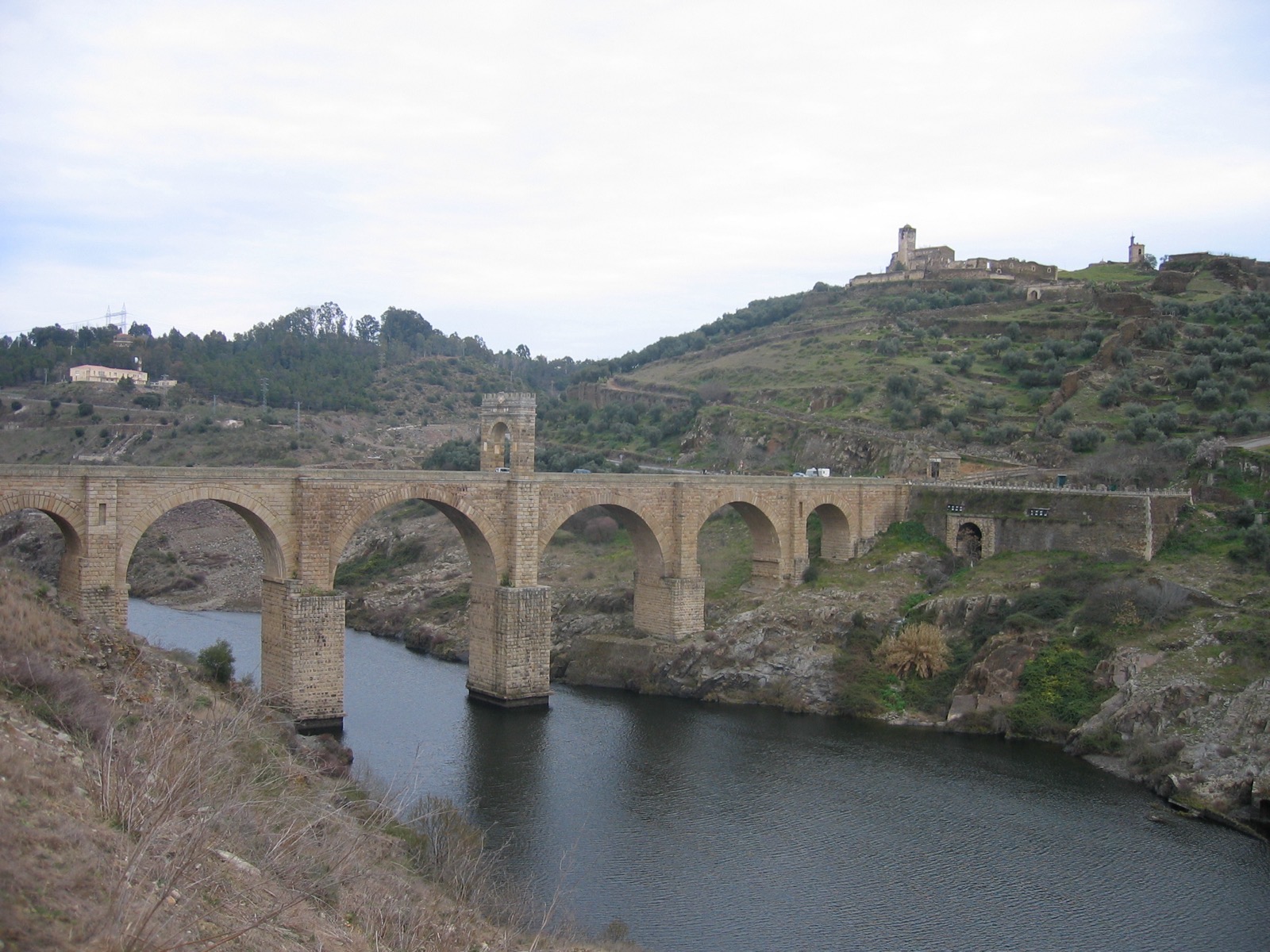
The Alcántara Bridge crosses the Tagus River in western Spain on six stone arches, built between 104 and 106 AD under a commission from the emperor Trajan and completed by the architect Gaius Julius Lacer, who was later buried in a small temple built at one end of the bridge, according to the ancient-history reference site Livius. An inscription on the archway over the bridge's central pier reads "Pontem perpetui mansurum in saecula," commonly translated as "I have built a bridge which will last forever," a boast carved directly into stone that most engineers would hesitate to make about anything.
By the standard the inscription itself set, the boast has held up better than most. According to Wikipedia's sourced account (checked 13 October 2026) of the bridge's history, the Alcántara Bridge "has suffered more damage from war than from the elements over the years": Moorish forces destroyed one of its smaller arches in 1214, not rebuilt until 1543; Spanish troops blew up a second arch in 1760 to slow a Portuguese advance, repaired in 1762 under Charles III; the same arch was destroyed again in 1809 by Wellington's forces during the Peninsular War; and much of the bridge was destroyed once more in 1836 during the Carlist Wars, rebuilt in 1860, with its main piers finally given a full structural repair in 1969. Every one of those episodes was deliberate demolition by an army. In nearly 1,920 years, nothing about the arches' own compression logic has been the reason a section came down.
Why squeezing stone is nearly indestructible
The physics behind that durability is simpler than the bridge looks. An arch converts the weight pressing down on it into thrust that curves outward and down through the stone into two abutments, large anchoring supports at each end built to resist the sideways push, so that every stone in the arch ends up squeezed by its neighbors, never pulled apart from them. That distinction matters because stone and unreinforced masonry are, by their nature, extremely strong in compression and comparatively weak in tension. Unlike a truss bridge, whose triangulated members are engineered to carry tension in some members and compression in others, a well-shaped arch can be built almost entirely from a material that is only good at one of those two things, because the geometry itself is doing the work of never asking the stone to do the other.
Getting that geometry exactly right, though, was an unsolved problem for most of architectural history, until Robert Hooke announced in 1675 that he had found "a true mathematical and mechanical form of all manner of Arches for Building," then hid his actual method inside a Latin anagram published as an appendix to an unrelated book on helioscopes, a common 17th-century tactic for claiming credit for a discovery without giving competitors the working details, as recounted in Plus Magazine's account of the puzzle. Hooke died in 1703 without ever publishing the solution himself; his executor decoded and released it in 1705 as "ut pendet continuum flexile, sic stabit contiguum rigidum inversum," or "as hangs the flexible line, so, inverted, will stand the rigid arch." The shape a chain naturally settles into when it hangs freely under its own weight, a curve called a catenary, is the exact same shape that, flipped upside down, carries a load in pure compression with no tendency to bend at any point along it.
The assumptions behind a 1966 masonry stability theorem
Hooke's catenary answered what the ideal arch shape looks like; three centuries later, the Cambridge engineer Jacques Heyman answered a related and more practical question, how to tell whether an arch that already exists, built to some shape or another, centuries ago and by trial and error rather than calculus, is actually safe. In a 1966 paper titled "The Stone Skeleton," published in the International Journal of Solids and Structures, Heyman worked from three deliberately simplified assumptions about masonry, that it has essentially no tensile strength, effectively unlimited compressive strength, and that its blocks do not slide against each other, as summarized in an engineering literature review of the theorem's continued use. From those assumptions Heyman proved that an arch is stable if even one possible "thrust line," the specific path the compressive force actually takes as it travels through the stone, can be found that stays entirely within the arch's own physical thickness at every point.
Under those assumptions, stability can be assessed from geometry and the loading. A real bridge still requires checks on material strength, sliding and the condition of its supports; an unchanged outline alone does not prove that weathered masonry remains safe. Engineers now run Heyman's thrust-line analysis on centuries-old arches with computer models built decades after the stone was cut, feeding in a structure's actual measured shape rather than an idealized drawing of it. A 2023 study did something comparable with a Therizinosaurus claw, building a digital model to test how the claw would have handled real mechanical stress millions of years after the animal that grew it was gone. The claw study used finite-element stress modeling, while the arch theorem uses idealized masonry assumptions. Measured geometry matters in both analyses, but neither comparison makes material properties irrelevant to a real structure. A cantilever bridge solves the balance problem in the opposite way, demonstrated in 1887 with a man balanced between two chairs, a human model for a design that would soon hold the world span record for 27 years.
The bridge that let the flood through on purpose
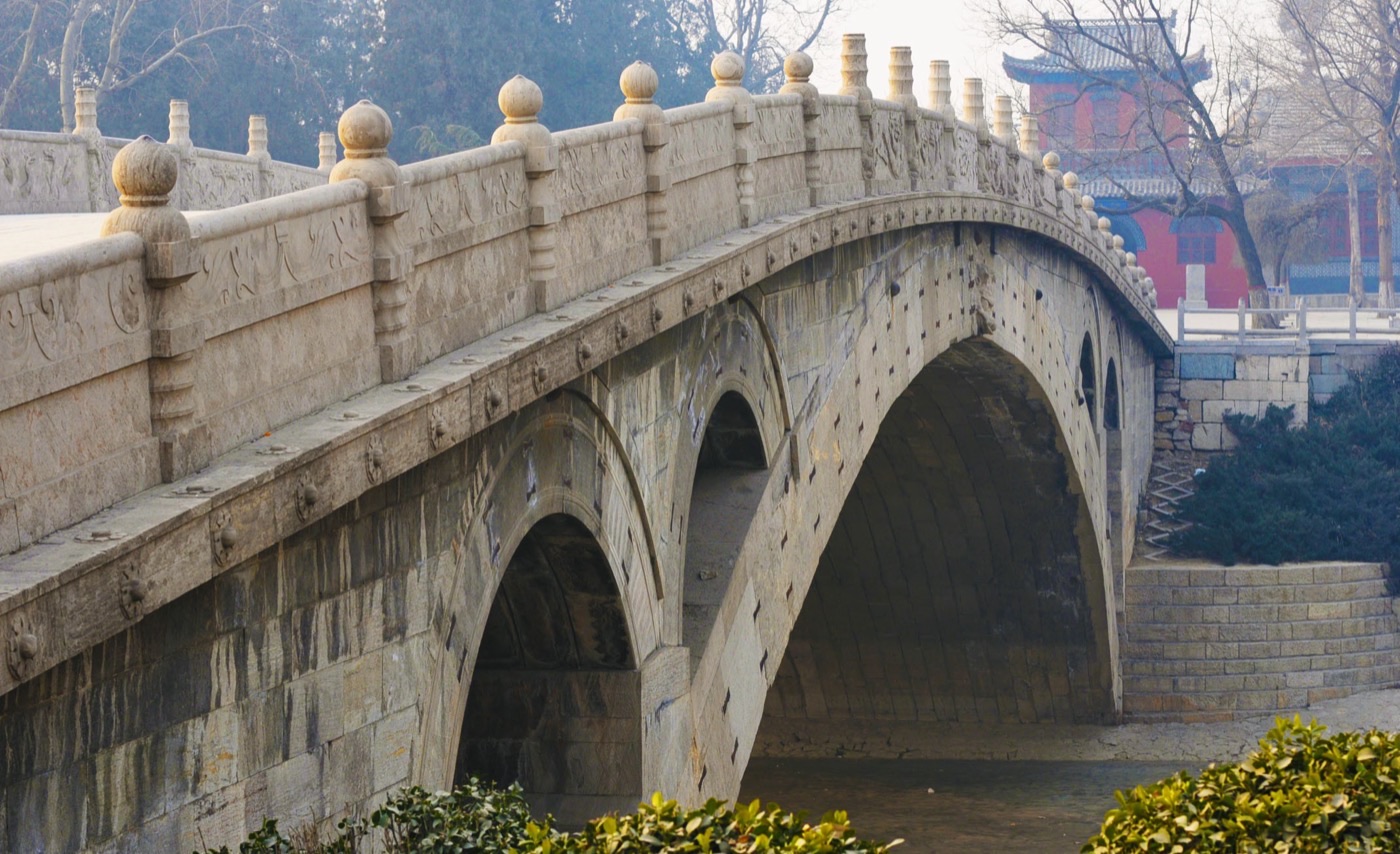
China's Zhaozhou Bridge, also called the Anji Bridge, crosses the Xiao River in Hebei province and is, according to Wikipedia's engineering summary (checked 13 October 2026) of the structure, the world's oldest surviving open-spandrel segmental stone arch bridge, built between 595 and 605 AD under the Sui dynasty and credited to a craftsman named Li Chun. Its main arch is not a full semicircle but a shallower segment, assembled from 28 separate curved limestone slabs running side by side across the bridge's width and locked together with iron clamps shaped like bow ties, a design that lets the arch flex slightly under load so that a crack in one slab does not bring down the whole structure. Sixth-century masons in Hebei were not the only pre-modern engineers who got more out of ordinary material by shaping it cleverly, not by reaching for something stronger; Inca administrators ran an empire's records on knotted cords tied from local fiber, with no metal and no paper anywhere in the system, because the knots themselves could hold everything the job required.
The bridge's more consequential innovation sits at each end of that main arch: two small open archways, cut straight through the spandrel, the solid stonework that would otherwise fill the space between the arch's curve and the flat road surface above it. Those four small openings cut the bridge's total dead weight by roughly 15 percent, about 700 tons, according to Wikipedia's structural breakdown (checked 13 October 2026) of the design, easing the load on the abutments, and they let river water pass through during floods instead of slamming full force against solid stone. A Tang dynasty inscription added roughly 70 years after construction credits the four small arches with breaking "the anger of the roaring floods" and calls the whole design a "master-work." The American Society of Civil Engineers dedicated the bridge an International Historic Civil Engineering Landmark in 1991, and it is still open to foot traffic today, more than 1,400 years after Li Chun's crew finished it.
_Bridge_2011.jpg)
Same physics, 552 meters later
The compression logic Hooke encoded in a 1675 anagram scales up dramatically in modern steel construction. The Chaotianmen Bridge, a road-and-rail crossing over the Yangtze River in Chongqing, China, opened in 2009 with a main arch span of 552 meters, edging past Shanghai's 550-meter Lupu Bridge, completed in 2003, to briefly become the longest arch bridge span in the world. China kept building bigger: the Pingnan Third Bridge in Guangxi took the record in 2020 with a 575-meter span, and a second Guangxi crossing, Tian'e-Longtan, pushed it further still to 600 meters in 2024, the current record as of 2026.
Chaotianmen is technically classified as a continuous steel truss arch, meaning it borrows from both structural families covered here: the overall curve still channels its main load into compressive thrust the way any arch does, while a triangulated steel web, the same triangle-based logic that makes a truss bridge rigid, stiffens the arch itself and helps it carry the uneven, shifting loads of rail and road traffic that a pure masonry arch was never asked to handle. The underlying idea, though, a curve that keeps its material in compression, is the same one an unnamed Roman mason was leaning on when he carved a promise of permanence into the Alcántara Bridge two millennia earlier, a promise that has turned out to be more accurate than any inscription has much right to be.