_-_Guelph,_Ontario_2016-02-17.jpg)
What actually separates a pseudoscorpion from a scorpion
A winged animal with an upturned rear end is a different identification problem. The pseudoscorpion and scorpionfly comparison places their legs, pincers and reproductive structures side by side.
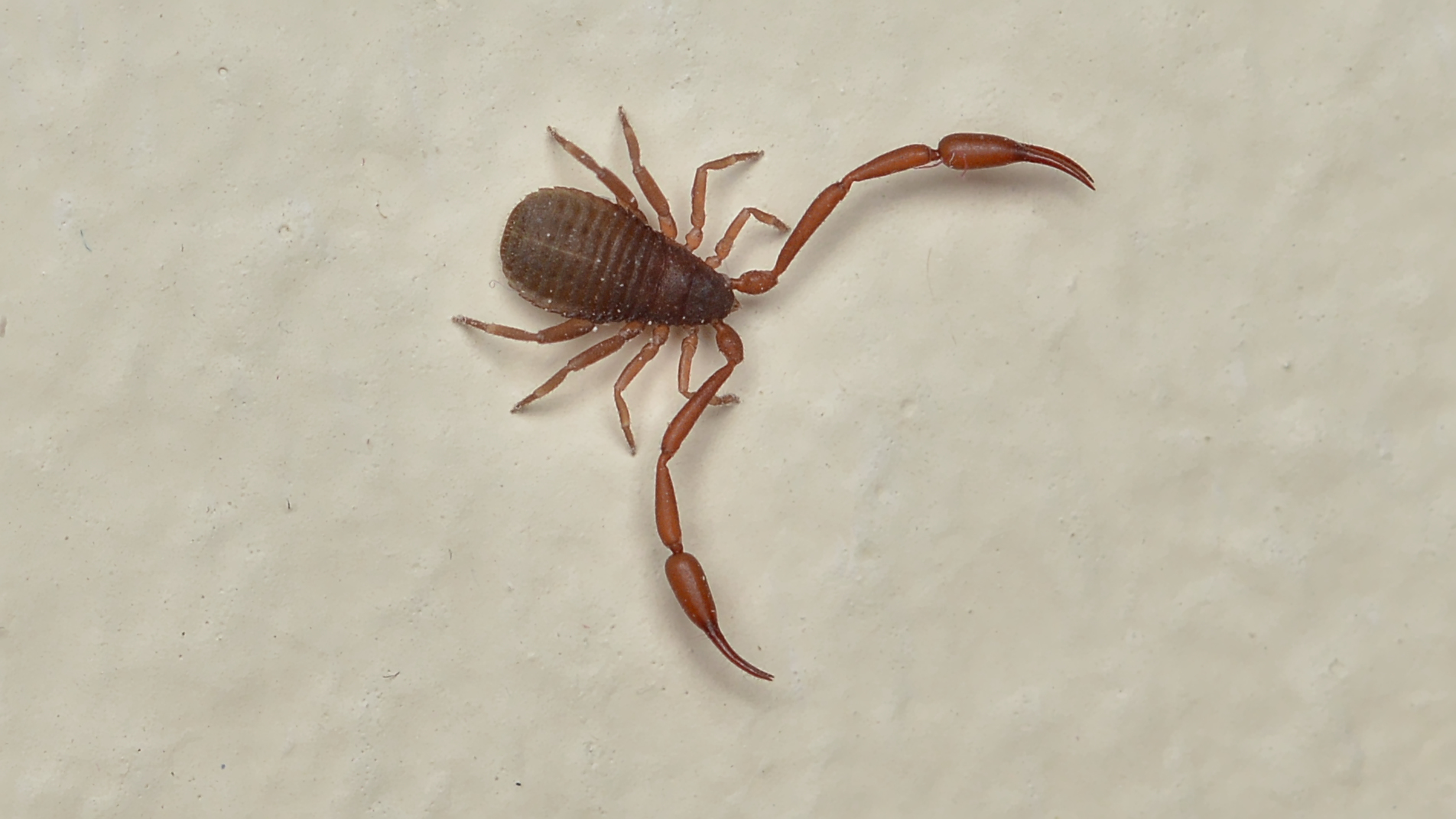
A pseudoscorpion looks like a miniature scorpion that lost its tail: a flat, pear-shaped body, usually 2 to 8 millimeters long, with a pair of pincer-like pedipalps out front that resemble a scorpion's claws. What it does not have is the part that makes a scorpion dangerous, the segmented tail ending in a venom-injecting stinger. Pseudoscorpions have no tail at all, which is exactly what the name is pointing at: pseudo-, meaning false. Despite that name, the group is not defenseless or venom-free. The clearest anatomical line inside the order runs through venom: pseudoscorpions in the suborder Iocheirata, meaning "poison hand," carry venom glands built into one or both fingers of their pincers, opening through a duct near the fingertip, while the rest of the order does not. Older classifications lumped every non-venomous lineage into a single suborder called Epiocheirata, "gentle hand," but a 2019 study in Molecular Phylogenetics and Evolution, led by Ligia Benavides, tested that grouping with genome-scale data and found it does not hold up as a natural group; current classification instead splits the non-venomous lineages into two separate suborders, Heterosphyronida and Atoposphyronida, alongside Iocheirata, plus a fourth suborder known only from a single Paleozoic fossil family. Iocheirata still makes up the great majority of living species and, per that same 2019 study, diversified mostly during the Mesozoic.
The order is also far larger than its low public profile suggests. The World Pseudoscorpion Catalog, the taxonomic reference maintained through the Natural History Museum Bern, listed 4,197 described species across 474 genera as of its 2022 update, a count cited consistently across recent species-description papers on the group. New species keep turning up in caves and leaf litter on every continent except Antarctica; a 2024 review in Global Ecology and Conservation cited the same catalog while cataloging the group's conservation status, and taxonomists described a new genus and five new Colombian species in a single 2023 paper alone. For a creature small enough to go unnoticed under a rock or inside a stack of books, that is a striking amount of undocumented diversity still being filled in one paper at a time.
The venom nobody could study directly until 2019
Knowing that most pseudoscorpions have venom glands is different from knowing what is inside them, and for most of the order's scientific history nobody had a practical way to find out. Venom yields from an animal a few millimeters long are vanishingly small, and standard extraction methods built for scorpions or spiders do not scale down cleanly. A 2019 study in Toxicon, developed with the house pseudoscorpion Chelifer cancroides, worked out a non-invasive collection method that, for the first time, yielded pure venom samples with minimal contamination from other body fluids, opening the door to chemical analysis that had not existed before.
A parallel approach sidestepped the extraction problem entirely by sequencing genetic material instead of venom itself. A 2018 study in the journal Toxins, led by Carlos E. Santibáñez-López and colleagues, sequenced the first venom-gland transcriptome from any pseudoscorpion, working with a different species, Synsphyronus apimelus. From 238,331 assembled transcripts, the team annotated 131 as putative venom components with similarity to known arachnid toxins, and found transcripts coding for enzymes were the most diverse category, followed by protease inhibitors, cysteine-rich peptides, and thyroglobulin-1-like peptides. That enzyme- and inhibitor-heavy profile marked pseudoscorpion venom as compositionally distinct from the neurotoxin-dominated venoms typical of scorpions and many spiders, the fourth independently evolved venomous arachnid lineage to get this kind of molecular look, after scorpions, spiders, and ticks.
From cataloging compounds to testing whether they do anything
Sequencing transcripts only shows what genes the venom gland is switched on to make; it does not prove those proteins end up in functional venom or what that venom actually does to prey. A 2021 Toxicon study built on the 2019 collection method to close part of that gap, analyzing venom drawn directly from Chelifer cancroides and identifying the first confirmed genuine toxins described from any pseudoscorpion, alongside evidence that a large share of the venom's components were novel, without close matches in existing toxin databases. A 2022 follow-up in Toxins picked one of those peptides, named Checacin1, and ran it through a battery of activity tests, finding it has measurable antimicrobial, insecticidal, and cytotoxic effects, the first time a pseudoscorpion venom peptide had documented pharmacological activity of any kind.
Two 2025 studies pushed the same "does it actually work" question further, using a different species entirely, the African pseudoscorpion Ammogarypus lawrencei. A proteo-transcriptomic analysis in Toxicon, led by Jonas Krämer and colleagues, found this species' venom dominated by cysteine-rich peptides bearing moderate similarity to neurotoxins from other arachnids, with enzymes present but reduced to a minor, likely predigestive role, a different balance than the enzyme-heavy S. apimelus profile from 2018. A companion study in Frontiers in Pharmacology then took one specific peptide identified in that venom, Ammogarypin, and tested it directly on live animals rather than just comparing its sequence to known toxins. Injected into Drosophila suzukii fruit flies, it caused spastic paralysis and death; injected into Myzus persicae aphids, the effect was much milder, and feeding either insect the peptide rather than injecting it produced no measurable effect at all. The peptide also showed only marginal antibacterial activity and no toxicity to mammalian cells or horse red blood cells in side tests. The researchers read that pattern as evidence Ammogarypin genuinely functions in subduing prey, but as a poor near-term candidate for an agricultural bio-insecticide, since its effects depend on injection and vary sharply between insect species.
The book scorpion that outlived its own classification
Chelifer cancroides, the species behind most of the venom-collection work above, has a much older claim to fame: it is the most widely distributed pseudoscorpion species on Earth, common enough in houses, libraries, and old book collections to have earned the common name "book scorpion." Carl Linnaeus described it in the 1758 tenth edition of Systema Naturae, the same edition that founded modern biological naming, but he did not get its classification right on the first try. Linnaeus originally placed it as Acarus cancroides, in the mite genus, then reassigned it to Phalangium, the harvestman genus, in 1767; the entomologist Johan Christian Fabricius moved it again in 1775, this time into Scorpio. It took decades of further taxonomic work before pseudoscorpions were recognized as their own order, a confusion that mirrors the same "what even is this thing" reaction the animal still gets from people who find one indoors today.
What a book scorpion is actually doing in a house is pest control. Chelifer cancroides preys on booklice, dust mites, carpet beetle larvae, and other small household insects, and it has no ability to bite or sting a human in any way that causes harm. Like other pseudoscorpions in the venomous suborder, it does carry venom glands in its pincers, but they are sized for immobilizing prey a fraction of a millimeter across, not for a defense that could register on skin as thick as a human's. Unlike vinegaroons, which have no venom apparatus at all and defend themselves with an acid spray, or camel spiders, which are venom-free despite older myths amplified by a viral 2004 photo, the book scorpion in a stack of old paperbacks does have functioning venom glands. It is simply never going to use them on something its own pincers cannot get a grip on.
How a wingless arachnid gets around the world
Pseudoscorpions have no wings and are too small to travel far on their own legs, which raises an obvious question for a group with species recorded on nearly every continent: how does a creature that size cross real distance? The answer researchers keep documenting is phoresy, hitching a ride by gripping onto a larger, mobile animal with a pincer and letting it do the traveling, without feeding on the carrier or harming it. A 2026 study in ZooKeys, led by Jana Christophoryová and colleagues, compiled 172 documented records of this behavior spanning 1761 to 2025, finding pseudoscorpions from 39 species across seven families have been recorded riding flies from 74 species across 30 families, the widest carrier list assembled for the behavior to date. The same paper added 11 previously unreported cases from four European countries, including first country records for two species, and one case of "multiple phoresy," several pseudoscorpions riding a single fly at once.
A separate study has turned up carriers well outside flies. A 2024 paper in Arachnologische Mitteilungen, by Yoram Zvik, Sharon Warburg and Efrat Gavish-Regev at the Hebrew University of Jerusalem, documented the first known case of a pseudoscorpion hitching a ride on a scorpion: out of more than 1,000 individual observations of the scorpion Birulatus israelensis in Israel, the researchers spotted the pseudoscorpion Nannowithius wahrmani riding on its back on just two occasions, both in late spring, expanding the list of documented pseudoscorpion carriers beyond insects entirely. Unlike a spider dispersing on silk in the wind, phoresy in pseudoscorpions is an active grip-and-release behavior, and the pattern researchers keep finding, species turning up on carriers and in countries not previously recorded, suggests researchers have only started mapping the true scope of the behavior, nowhere near finished cataloging it.