
Two animals, two misleading names
A tiny animal with obvious pincers and no tail fits the pseudoscorpion body plan. A long-snouted insect with patterned wings and an upturned abdominal tip fits a male common scorpionfly. The resemblance to a scorpion comes from the front end of one animal and the rear end of the other. They belong to different arthropod groups, so combining their names into a single kind of dangerous insect confuses an arachnid with an insect.
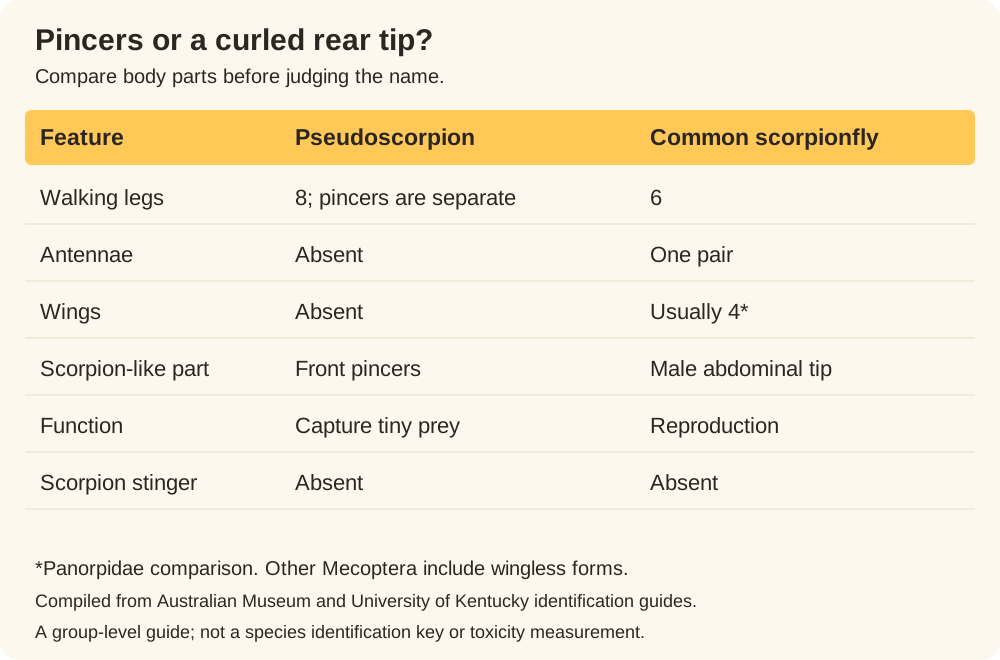
The comparison chart pairs the Australian Museum's pseudoscorpion identification characters with Kentucky's scorpionfly guide. Its scorpionfly column describes common scorpionflies in the family Panorpidae. It is a group-level identification aid, not a key that names every species or every member of the wider order Mecoptera.
Start with legs, antennae and the head
Count walking legs separately from pincers. The Australian Museum lists eight legs for a pseudoscorpion, with a separate pair of enlarged pedipalps ending in claws. Those pedipalps sit between the mouthparts and the first walking legs. A photograph can therefore appear to show ten limbs even though the animal has eight legs. Its antennae and wings are absent. If a large pair of claws dominates a small, flattened body, check where each appendage joins the body before deciding what you are looking at.
A common adult scorpionfly follows the insect arrangement: six legs and a pair of antennae. Its conspicuous face projects into a rostrum, the long snout that carries chewing mouthparts at the end. Texas A&M's field guide describes the narrow, patterned wings and threadlike antennae of Panorpa nuptialis. In a side-on photo, the snout can be easier to see than all the legs. That makes it a useful second character when foliage hides the underside.
Wings help, but their absence alone does not settle the identification. NC State's Mecoptera account notes that some members have reduced or absent wings. Wingless snow scorpionflies are a familiar exception to the usual image of a four-winged scorpionfly. Use several characters together; a cropped photograph of one wing or one claw leaves too much missing.
The curled tip belongs to the male
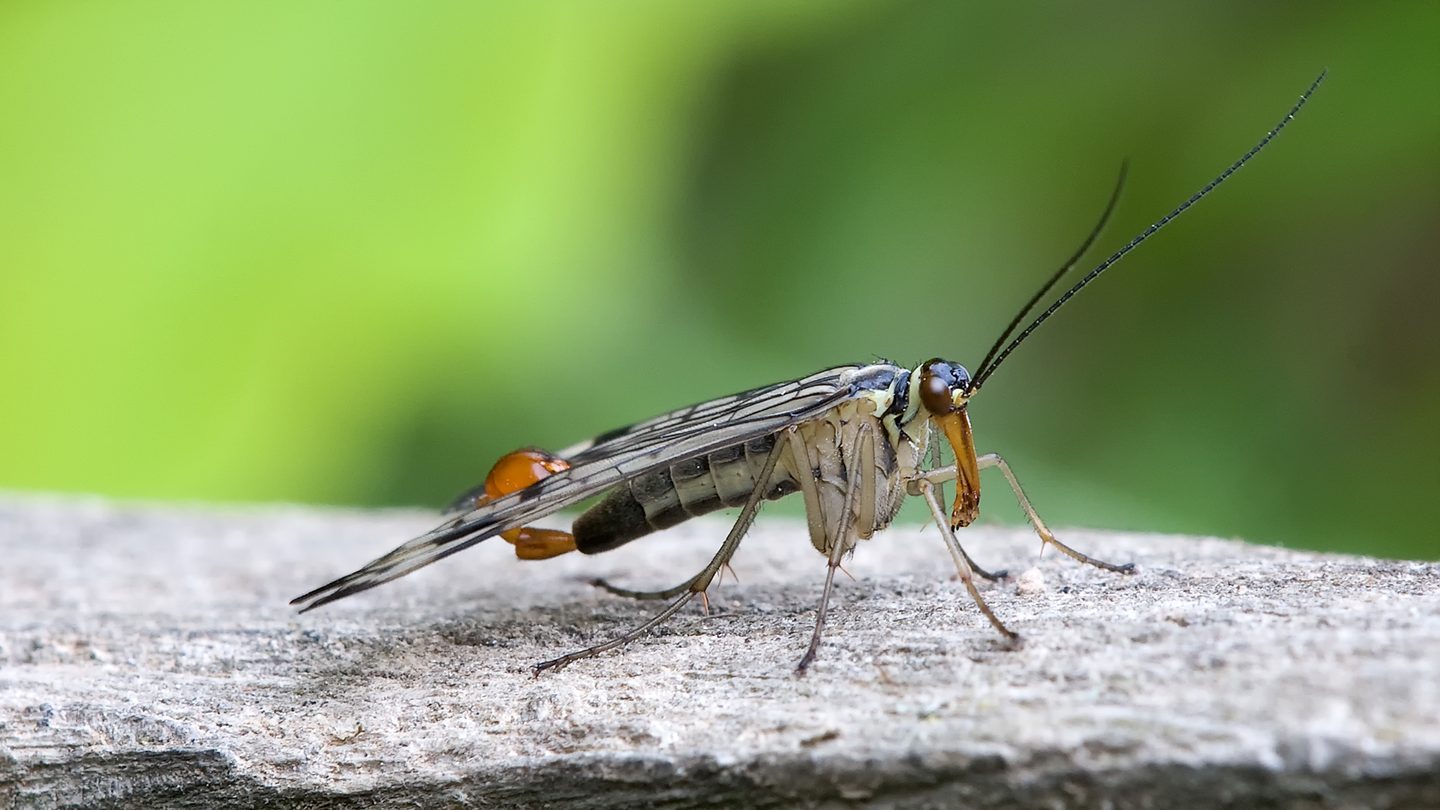
A male common scorpionfly's rear end looks threatening because the enlarged terminal segments curve back over the abdomen. Their function is reproductive. Mississippi State entomologist Blake Layton describes the end as a clasping structure used during mating. A scorpion's venom-injecting tail is a different anatomical arrangement. Similar silhouettes do not establish that two appendages perform the same job.
Kentucky's identification guide puts the practical answer plainly: "Scorpionflies cannot sting." It also says females lack the male structure. A scorpionfly without the curved tip can therefore be a female, rather than an animal that has lost its supposed stinger. When comparing pictures, check that the images show the same sex before treating a difference at the rear as evidence of a different kind of insect.
The hero photograph shows a male Panorpa communis, with the reddish tip turned upward behind its wings. It illustrates the misleading outline well. It does not show a venom apparatus, and the enlarged tip cannot be used to rank the insect's toxicity from a photograph.
Pincer venom is a different question
A pseudoscorpion can have genuine venom even though it poses no threat to people. The American Arachnological Society locates venom glands in the pincer fingers of the suborder Iocheirata, where venom passes through the fingertip to subdue prey. That taxonomic qualification matters. A general statement about pseudoscorpions should not become a claim that every species has an identical venom system.
Venom presence does not establish danger to a human. Minnesota Extension says the feeding glands are not harmful to people or pets. The prey described there include springtails, booklice and mites. The Australian Museum states: "The venom is used to paralyse prey and is not harmful to humans." The animal has no tail-mounted sting. For the chemistry and research behind this unusual delivery system, the separate pseudoscorpion guide follows the venom studies in detail.
A numerical toxicity ranking would need a specified substance, dose, test organism and method. The identification sources do not provide those measurements. They establish which structure is present and how it functions; they do not establish that one of these animals is a certain number of times more toxic than the other.
Where you find it is a clue, not a diagnosis
Pseudoscorpions occur in leaf litter and under bark or stones, as well as in buildings. Wisconsin Extension describes leaf litter, quiet indoor places such as closets, and humid bathrooms as places where they occur. Finding a tiny clawed animal near stored paper is therefore consistent with a pseudoscorpion, but the room itself cannot identify it. A clear view of the claws and rear of the body provides better evidence.
Common scorpionflies are associated with vegetation and woodland habitats. Texas A&M describes wooded areas and ravines; Mississippi State describes adults in woodland understory and along woodland edges. Their meals often include dead insects or other decaying material. Seeing one on a leaf is unsurprising. Seeing an insect indoors does not automatically turn it into a household pest, and neither location proves whether an appendage contains venom.
These observations explain why photographs of the two animals often look very different even before their limbs are counted. One may fill a magnified view of a speck on a wall; the other may sit visibly on foliage. Scale, habitat and color are supporting clues. They should stay behind body structure in the identification process.
Read a photograph without guessing the missing parts
First locate the head. On a pseudoscorpion, the conspicuous claws project forward; on a common scorpionfly, look for the elongated face and antennae. Then follow the body to its rear. Does the image show a short, rounded abdomen without a tail, or a longer insect abdomen with a curled terminal structure? Work through those characters on the same animal, rather than mixing the front of one reference image with the back of another.
Next count the legs that actually contact the surface. Mark any hidden leg as unknown. A side view can hide an entire row of limbs, and an overhead view can merge overlapping wings. Missing details in a picture are not biological absences. If the wing count or leg count is obscured, use the visible head and appendages as tentative clues and seek a clearer view before claiming a firm identification.
Finally compare the photograph with a named museum or university reference. Record which characters match and which remain unseen. A useful result can be "consistent with a common scorpionfly, sex unclear" without pretending to identify the species. This approach keeps the original question about a supposed stinger tied to observable anatomy. No handling experiment is needed to check whether a curved appendage has the shape described in the reference.
Do not extend the answer to every scorpion look-alike
The conclusion about these two groups does not cover every animal with claws or a tail. Vinegaroons have a slender sensory flagellum instead of a stinger, yet can release an irritating defensive spray. A missing venom-injecting tail therefore does not mean that every chemical defense has disappeared. The body part, the secretion and its route of delivery need to be considered separately.
Camel spiders provide another limit: they lack a confirmed venom apparatus but have powerful jaws that can cause a mechanical bite. Calling an animal nonvenomous does not describe everything it can do. Those examples are reasons to identify the actual group, not reasons to assign their defenses to a pseudoscorpion or scorpionfly.
For pseudoscorpion vs scorpionfly, the distinguishing features remain straightforward: front pincers on a wingless arachnid versus the long face and insect body of a common scorpionfly. Once those features match, the apparent weapons make sense. The tiny pincers serve feeding, while the male scorpionfly's curved rear serves reproduction. Neither is a scorpion stinger.