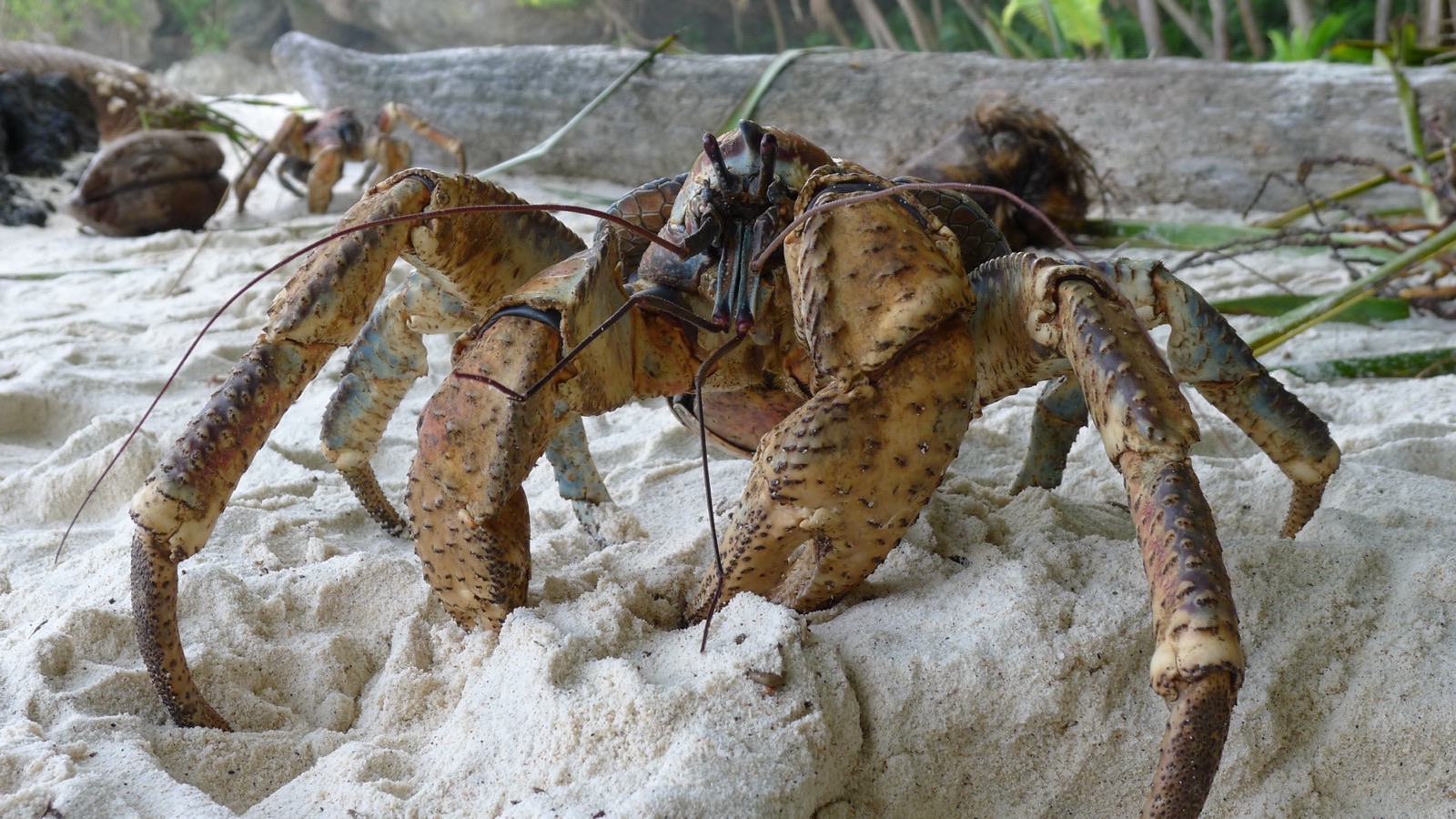

The largest land invertebrate on the planet
The coconut crab is not really a crab in the way a blue crab or a king crab is one; it is a hermit crab, the largest of roughly 15 species in the family Coenobitidae, and the only one that has abandoned the shell-carrying habit entirely. Juveniles tuck their soft abdomens into salvaged snail shells the way any hermit crab does, but as they grow, their exoskeleton hardens with deposited calcium carbonate until the crab no longer needs a shell at all. Freed from the size limit a borrowed shell imposes, adults can reach roughly a meter from leg tip to leg tip and weigh around 4.5 kilograms, making Birgus latro both the largest living land arthropod and the largest living land invertebrate of any kind.
It breathes through an organ called a branchiostegal lung, a tissue partway between a gill and a true lung that only works when kept moist, which is why the crab spends daylight hours in humid burrows and uses its smallest pair of legs to wet the organ with water carried from its own mouthparts. It cannot swim as an adult and drowns if submerged for more than about a day, despite depending entirely on the ocean to release its larvae, which spend three to four weeks drifting as plankton before returning to land as tiny hermit crabs. Growth afterward is slow: sexual maturity takes about five years, and Britannica and other sources put total lifespan past 60 years, with at least one researcher estimating some individuals may take decades longer than that to reach full size. Terrestrial crustaceans come in very different sizes: at the opposite end from this giant sits the common woodlouse, a terrestrial isopod barely big enough to see clearly underfoot, with more than 4,100 known species worldwide.
The coconut-opening technique scientists spent a century doubting
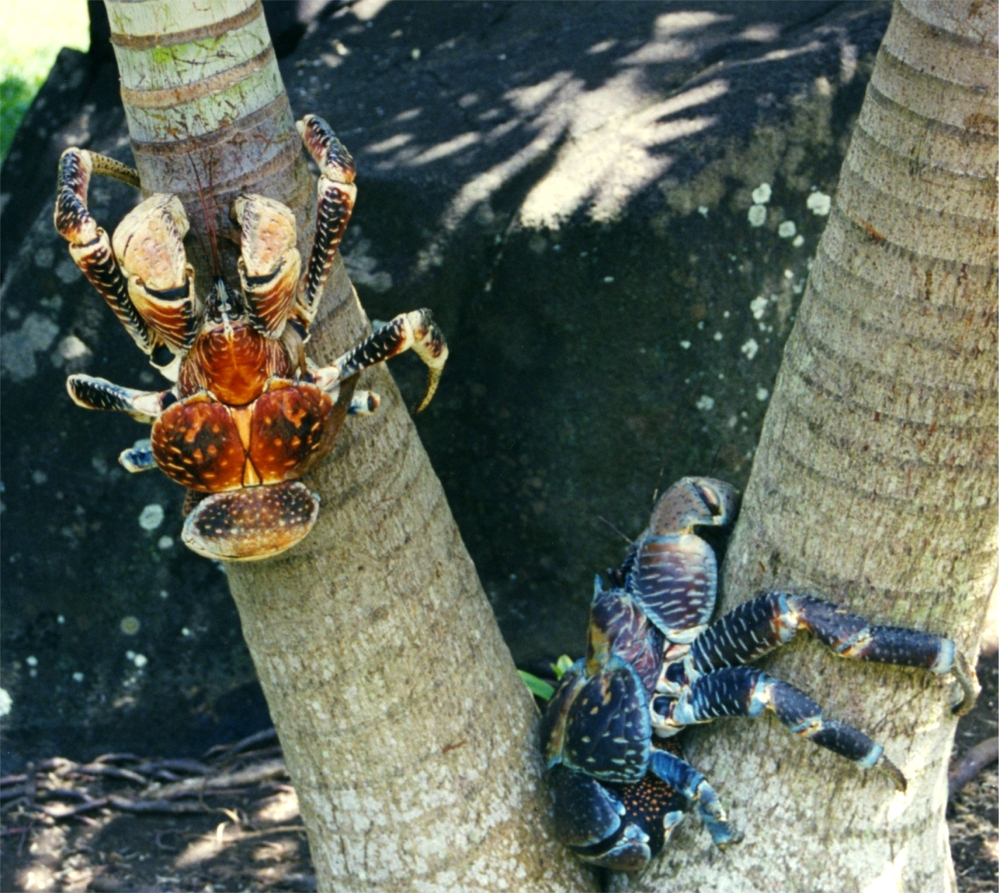
The crab's most famous claim (that it can crack open a coconut with its own pincers) was treated as folklore by Western science for far longer than most people would guess. Naturalist Thomas Hale Streets, writing in 1877, doubted that the animal even climbed trees to reach coconuts in the first place, and skepticism about whether it could actually open one persisted as late as the 1970s. It took field biologist Holger Rumpf, working in the 1980s, to confirm and document the exact method: the crab uses its large claws to strip away husk fibers, always starting from the end with the coconut's three germination pores, then hammers its pincer against one pore repeatedly until it breaks through. Once inside, it switches to a smaller, tweezer-like pair of legs to pick out the white flesh, and the largest individuals are strong enough to crack the hardened shell itself into more manageable pieces.
The force behind that technique has been studied directly. Oka and colleagues measured 29 wild coconut crabs in 2016, recording a maximum of 1,765.2 newtons. Scaling the relationship between body mass and force to a previously reported 4-kilogram animal gave an estimated 3,300 newtons, about 742 pound-force; that upper figure was a prediction for a larger crab, rather than a measurement on one. It is the reverse of a reputation that outran the evidence: where a feared creature usually turns out to be more myth than menace, here a genuinely startling claim about an animal's strength sat unconfirmed for a century simply because almost no one had watched it happen in the wild.
.jpg)
"Ruler of the atoll": the 2016 discovery that these crabs hunt birds
In February 2016, Dartmouth biologist Mark Laidre was cataloguing coconut-crab burrows on an uninhabited island in the Chagos Archipelago, in the middle of the Indian Ocean, when he found the carcass of an almost full-grown red-footed booby inside one. He assumed at the time that the bird had simply died elsewhere and been dragged in. Then, in March, in the middle of the night, he watched a coconut crab attack a booby asleep in a tree, break its wing with a claw, and drag it to the ground; within about twenty minutes, five more crabs converged on the smell of blood and spent the next several hours tearing the bird apart. "I didn't have the heart to videotape five coconut crabs tearing apart the bird later," Laidre later told Science News. "It was a little bit overwhelming. I had trouble sleeping that night." He also heard a similar account secondhand, from a local plantation worker who described a crab emerging from its burrow in broad daylight to seize a booby that had landed nearby and pull it into the ground; the bird, he said, never emerged.
What made the discovery more than a single dramatic anecdote was the pattern Laidre found when he walked survey transects counting crabs and bird nests across the archipelago's islands. On Diego Garcia, a 15-kilometer transect turned up roughly 1,000 crabs and not one ground-nesting bird; on a nearby crab-free island, ground nests of noddies were abundant. Laidre published the finding in Frontiers in Ecology and the Environment in November 2017, describing the coconut crab as a "ruler of the atoll" whose presence or absence appears to determine which islands ground-nesting seabirds can use at all: a single burrowing scavenger reshaping which animals share its island by sheer force of appetite, in a class with other apex ocean predators whose presence alone rearranges an entire ecosystem.
A vulnerable giant, and a decline harder to reverse than the one that caused it
For an animal capable of hunting birds, the coconut crab is now the more threatened party in most of its range. The IUCN first listed it as Vulnerable in 1981, downgraded that to Data Deficient in 1996 for lack of population data, then reassessed it as Vulnerable again in an evaluation dated August 2018 (published 2020), a listing that identifies habitat loss, coastal tourism development, and overharvesting for meat as the primary drivers of a documented decreasing population trend. The species has already been wiped out across most of its former mainland range, including mainland Australia, Madagascar, and Réunion, and survives today mainly on islands and atolls that were harder for hunters and developers to reach. In parts of its range the crab is prized as a delicacy and reputed local aphrodisiac, which has driven targeted harvesting even where legal size limits or egg-bearing-female protections now exist, such as in Guam and the Federated States of Micronesia. A more detailed 2022 analysis by Neil Cumberlidge and colleagues in the Raffles Bulletin of Zoology, built on the same assessment, adds introduced predators and road deaths near tourist infrastructure to the list of pressures, and warns that sea-level rise and ocean acidification are likely to compound the damage in the decades ahead.
It is a slower-motion version of a wildlife collapse playing out elsewhere: a slow-growing, long-lived species being drawn down faster than it can reproduce, in a decline visible mainly to researchers who happen to be counting.
The Amelia Earhart theory, and the missing physical evidence
The coconut crab's appetite for carrion has fed one more theory, considerably more speculative than anything above. The International Group for Historic Aircraft Recovery (TIGHAR) has long argued that Amelia Earhart and navigator Fred Noonan did not crash into open ocean in July 1937 but instead came down on Nikumaroro, a remote Pacific atoll, where Earhart eventually died stranded. Part of that hypothesis rests on a partial skeleton found on the island by British colonists in 1940, whose bones were shipped off for analysis and subsequently lost, and on a 2007 experiment in which TIGHAR researchers left a small pig carcass on the island to observe what coconut crabs would do to it. According to TIGHAR president Patricia Thrasher, the bones were stripped and scattered within a matter of weeks, offering a plausible mechanism for how a castaway's remains could have been dispersed before anyone returned to look for them.
That evidence is suggestive rather than conclusive. No wreckage of Earhart's plane has ever surfaced on or near Nikumaroro, the lost 1940 bones can no longer be re-examined, and no confirmed Earhart remains have ever been recovered on the island; the theory remains unproven on that evidence. It is a reminder that the same efficient, opportunistic appetite for anything dead on the ground that makes coconut crabs formidable ecological actors also makes them a tempting explanation for genuine mysteries the physical evidence alone can't fully settle.