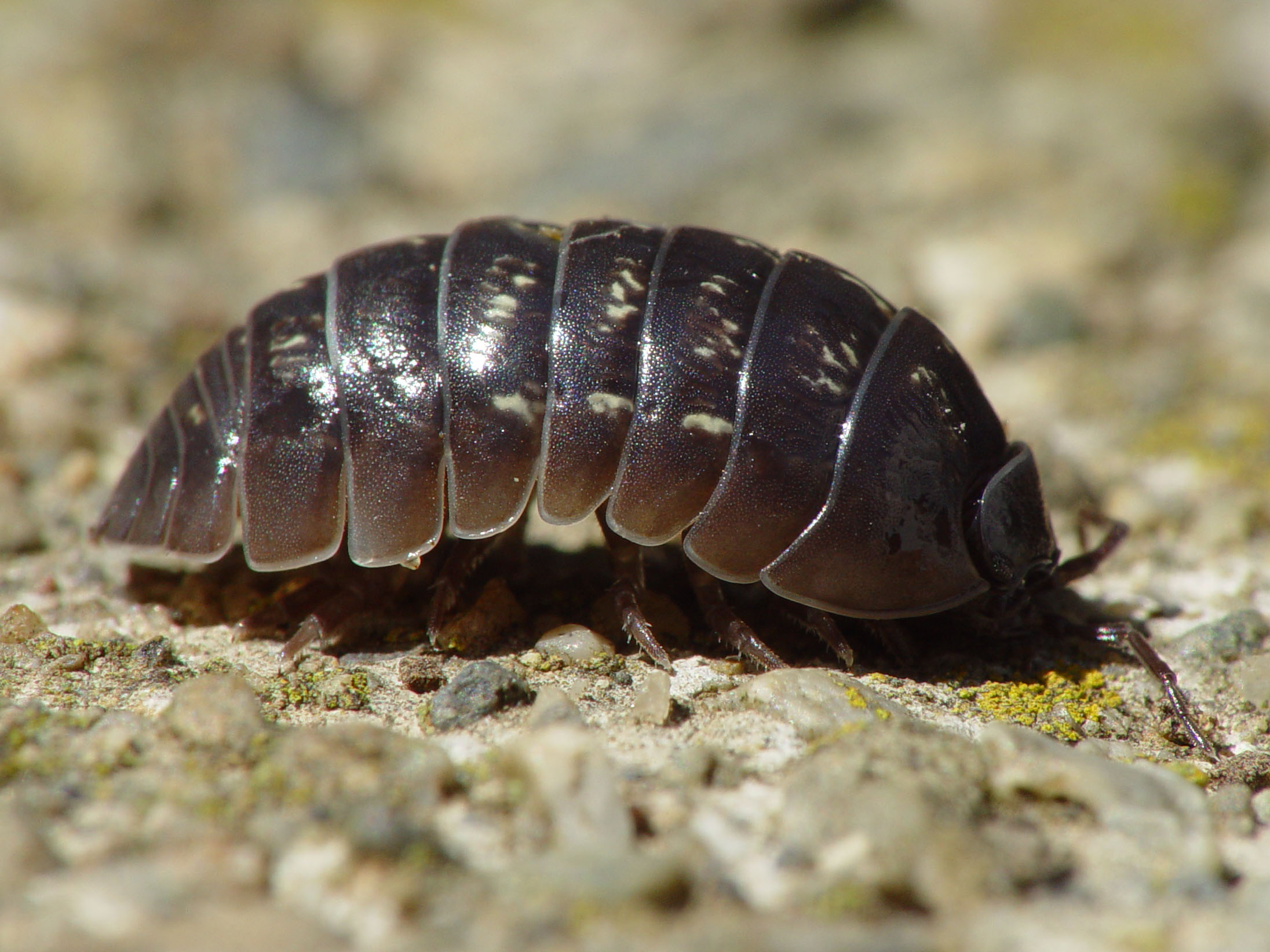
Not an insect: a crustacean that only looks the part
A woodlouse has seven pairs of legs, no wings, and a hard, segmented, gray-to-brown body that reads as vaguely insect-like at a glance, but every one of those traits actually points toward its real relatives: crabs, shrimp, and lobsters. Woodlice belong to the order Isopoda within the crustacean subphylum, and the terrestrial branch of that order, suborder Oniscidea, currently counts more than 4,100 described species spread across roughly 568 genera and 38 to 39 families, a tally that keeps climbing as taxonomists describe new species from caves and leaf litter almost every year. The name itself is not standardized. Depending on region, the same or closely related species get called woodlice, pill bugs, roly-polies, sowbugs, potato bugs, or armadillo bugs, and those names are not fully interchangeable. Another crustacean lineage includes a much larger land animal: the largest land-dwelling arthropod alive is the coconut crab, a hermit-crab relative whose adults no longer carry borrowed shells, although its larvae still develop in the sea.
A familiar distinction concerns the ability to roll up, which occurs in more than one family. Pill bugs, most familiarly the common pill woodlouse Armadillidium vulgare in family Armadillidiidae, can roll their entire body into a tight, near-perfect sphere when disturbed, a defensive posture called conglobation that protects the vulnerable legs and antennae inside a smooth armored shell. Sowbugs, including the common rough woodlouse Porcellio scaber and species in genus Oniscus, look similar and are often mistaken for the same animal, but they lack the plate structure that allows a complete roll and instead flatten or scatter when threatened; they also carry two short tail-like uropods projecting from the rear. Rolling forms also possess these appendages, with shapes suited to their defensive posture. "Roly-poly" and "pill bug," then, are commonly used for rolling woodlice, though regional names vary and do not define a single family.
Gills turned into lungs, kept damp to keep working
Isopods started out entirely marine, and the respiratory system every terrestrial species still carries gives that ancestry away. They never evolved a true insect-style tracheal network from scratch; woodlice repurposed the gills on their abdominal appendages, called pleopods, folding them into internal pockets called pleopodal lungs, sometimes described as pseudotracheae, that present a large, branching surface area to open air while limiting how much of it is exposed at once. A 2022 study in Arthropod Structure & Development, led by Naoto Inui and colleagues, tracked exactly when this structure forms in Porcellio scaber: lungs on the second pair of pleopods develop immediately after hatching and become functional at the next larval stage, while lungs on the first pleopod pair, which appear later in development, mature more gradually, a staggered developmental sequence the researchers read as evidence terrestrial isopods evolved distinct developmental mechanisms, including new tissue-folding steps, specifically to build this organ during their transition onto land.
Because that lung tissue is derived from gills, it functions best when kept moist, and a dried-out pleopodal lung loses much of its capacity to take up oxygen. That single constraint explains most of what looks like odd behavior in a backyard woodlouse: the reason they cluster under logs, stones, and damp mulch and avoid open, sunlit ground is not preference so much as respiratory necessity, a physiological leftover from an ancestor that never fully left the water behind.
Blue blood and a body built to store metal
Cut into a woodlouse and the blood, or hemolymph, that leaks out carries a faint blue tint, a sign that oxygen transport runs on hemocyanin, a copper-based protein, in place of the iron-based hemoglobin vertebrates use. That copper does not stay only in circulation. Electron-microscopy and elemental-analysis studies of Armadillidium vulgare found copper concentrated inside storage granules in specialized S cells of the hepatopancreas, the isopod digestive gland, alongside zinc, evidence that this organ actively sequesters heavy metals, not simply processes them as waste.
That metal-hoarding behavior is what turned woodlice into a usable pollution instrument. A landmark study led by Stephen Hopkin, working with G.N. Hardisty and M.H. Martin, measured zinc, cadmium, lead and copper in the woodlouse Porcellio scaber and in soil and leaf litter across 89 sites spanning Avon and Somerset in southwest England, tracing a pollution gradient centered on a zinc, lead and cadmium smelting works at Avonmouth near Bristol. Later hepatopancreas-specific work on a related species found the organ alone can hold the large majority of an individual's total-body cadmium load, concentrated tightly enough that researchers have proposed woodlice as a standardized, low-cost bioindicator, sometimes informally called a 'woodlouse watch,' for tracking metal contamination in soil across different regions using one consistent, widely distributed animal.
The bacteria quietly rewriting who is female
In several isopod species, sex is not determined by chromosomes alone. Armadillidium vulgare can carry Wolbachia, an intracellular bacterium best known elsewhere for manipulating insect reproduction, and in this isopod the infection feminizes genetic males, individuals that would otherwise develop as ZZ males under the species' own chromosome-based sex determination, turning them into fully functional, egg-laying females instead. That alone would be a striking case of a parasite hijacking host reproduction, but a 2016 study in PNAS, led by Sébastien Leclercq with Julien Thézé, Mohamed Amine Chebbi, Isabelle Giraud, Bouziane Moumen, and colleagues, found the manipulation went further: a roughly 3-megabase segment of a feminizing Wolbachia strain's own genome had been horizontally transferred into the isopod's nuclear DNA, where that bacterial-derived DNA segment now itself functions as a newly evolved W sex chromosome, distinct from, and effectively replacing, the isopod's original W chromosome, which the same infection had previously driven toward loss.
A 2019 study in Molecular Biology and Evolution, by Mohamed Amine Chebbi, Tiffany Becking, Bouziane Moumen, Isabelle Giraud, Clément Gilbert, Jean Peccoud and Richard Cordaux, sequenced the full Armadillidium vulgare genome and placed that horizontal-transfer event in a broader context, describing the isopod's Z and W sex chromosomes as essentially undifferentiated at the molecular level, with an extremely small W-specific region, consistent with evolutionarily young sex chromosomes still being actively reshaped by the bacterial infection driving their turnover. Unlike the pseudoscorpions that hitch passive rides on flies to get around, the Wolbachia infecting Armadillidium vulgare is no passive passenger; it has partially rewritten the genome it lives inside.
One trip onto land, or several: new genomic evidence for a single origin
Whether terrestrial isopods evolved from a single marine ancestor that colonized land once, or from several separate lineages that made the same transition independently, stayed a genuinely open, back-and-forth question for years. A 2017 study in Organisms Diversity & Evolution, by Luana S.F. Lins, Simon Y.W. Ho and Nathan Lo, used a relaxed molecular clock to date the origin of terrestrial isopods to roughly 289.5 million years ago, with a wide 95% credibility interval spanning about 220 to 359 million years, but found no molecular support for the monophyly, meaning single common ancestry, of suborder Oniscidea in any of their analyses, conflicting with the classical view built on shared physical traits. A 2019 study in Scientific Reports, by Andreas C. Dimitriou, Stefano Taiti and Spyros Sfenthourakis, added independent genetic markers and reached the same conclusion, arguing the field needed to revise its scenarios for how terrestrial isopods originated altogether.
A 2024 study in Proceedings of the Royal Society B, by Jessica A. Thomas Thorpe of the Wellcome Sanger Institute, revisited the question with far more genetic data than either earlier study had available: 970 single-copy orthologous genes shared across 36 isopod species and four other peracarid crustaceans, the first analysis of isopod relationships to draw on nuclear genomic and transcriptomic data at this scale. That analysis found compelling support for a monophyletic Oniscidea after all, and traced the earlier conflicting results to a specific technical cause, long-branch attraction artifacts, a known statistical pitfall in older studies that relied more heavily on nuclear ribosomal RNA sequences. The revised dating pointed to a Permo-Carboniferous origin of isopod terrestriality, a single transition that, according to the newest and most data-rich analysis, arrived tens of millions of years after centipedes had already adapted to life on dry ground, making terrestrial isopods, alongside centipedes, among the small number of arthropod lineages that made a successful, lasting move off the water.