
What the reported death actually establishes
A clinical paper published in 2025 describes a man bathing in a shallow tributary of the Tocantins River in Brazil. His companions reported seeing him contact an electric eel, struggle and convulse at the surface, then disappear underwater. When they recovered him, he was taken to hospital and declared dead on arrival. The encounter happened in September 1997, so the publication date should not be mistaken for the date of the accident.
The authors suspected that repeated discharges had locked his muscles into sustained contractions, leaving him unable to keep his airway clear. Foam in the airways was consistent with drowning. They did not document a fatal heart rhythm or a measured current passing through his chest. Their abstract says that "the victim likely drowned because of muscle contracture." The word "likely" matters: this is an explanation supported by the observations, with gaps in the medical record.
The eel was captured after the incident, but the available photograph was not clear enough to establish its species. The researchers suggested a likely identification from the location. That is weaker evidence than examining an identified specimen, and the lethal encounter cannot be assigned a measured voltage by matching it to a species record.
Loss of movement while submerged can make the encounter fatal even without a demonstrated cardiac injury. The paper supports a serious drowning hazard after contact with an eel. It cannot tell a swimmer the probability of that outcome, because it does not count all encounters, all shocks or all people exposed in the region.
A survivor shows why a visible burn is not required
The other case in the same report involved a young man in an urban area flooded by the Jari River. Witnesses described an eel shock, and he reported tremors and an inability to move. Family and others transported him by boat for treatment. Movement returned, although muscle contractions and weakness in his lower limbs persisted during his care.
Blood tests showed raised muscle-injury markers, which the authors interpreted as consistent with rhabdomyolysis: damaged muscle releasing its contents into the blood. They reported a negative troponin test. The combination does not justify retelling the case as a confirmed heart attack. Nor does the absence of a skin wound erase the evidence of internal muscle injury.
Neither patient had documented external burns. These two observations help explain how an encounter can be severe without the burn pattern people associate with a damaged power cable. They do not prove that an eel can never cause a burn under any conditions. The paper also does not give a full recovery timeline for the survivor; a return of movement should not be rewritten as a documented, complete recovery.
860 volts is a specimen record, not a human dose
In a 2019 study in Nature Communications, researchers distinguished three electric-eel species: Electrophorus electricus, E. varii and E. voltai. The last produced a discharge of 860 volts in their measurements. Cornell's account of the research identifies E. voltai as the species behind that result. It should not be attributed to every fish called an electric eel.
The study measured the discharge across electrodes contacting the head and tail of the animal while it was out of water on a nonconductive surface. That describes the measurement setup. It does not mean a nearby person receives the same voltage across the same body parts. The route through water and tissue changes the circuit.
Voltage is an electrical potential difference. Current is the flow of charge through a particular path. To interpret injury, the path and duration matter as well as the eel's output. A number printed beside a species name cannot supply the missing details of a human encounter. In particular, the 860-volt measurement does not retroactively establish the electrical exposure in either clinical case.
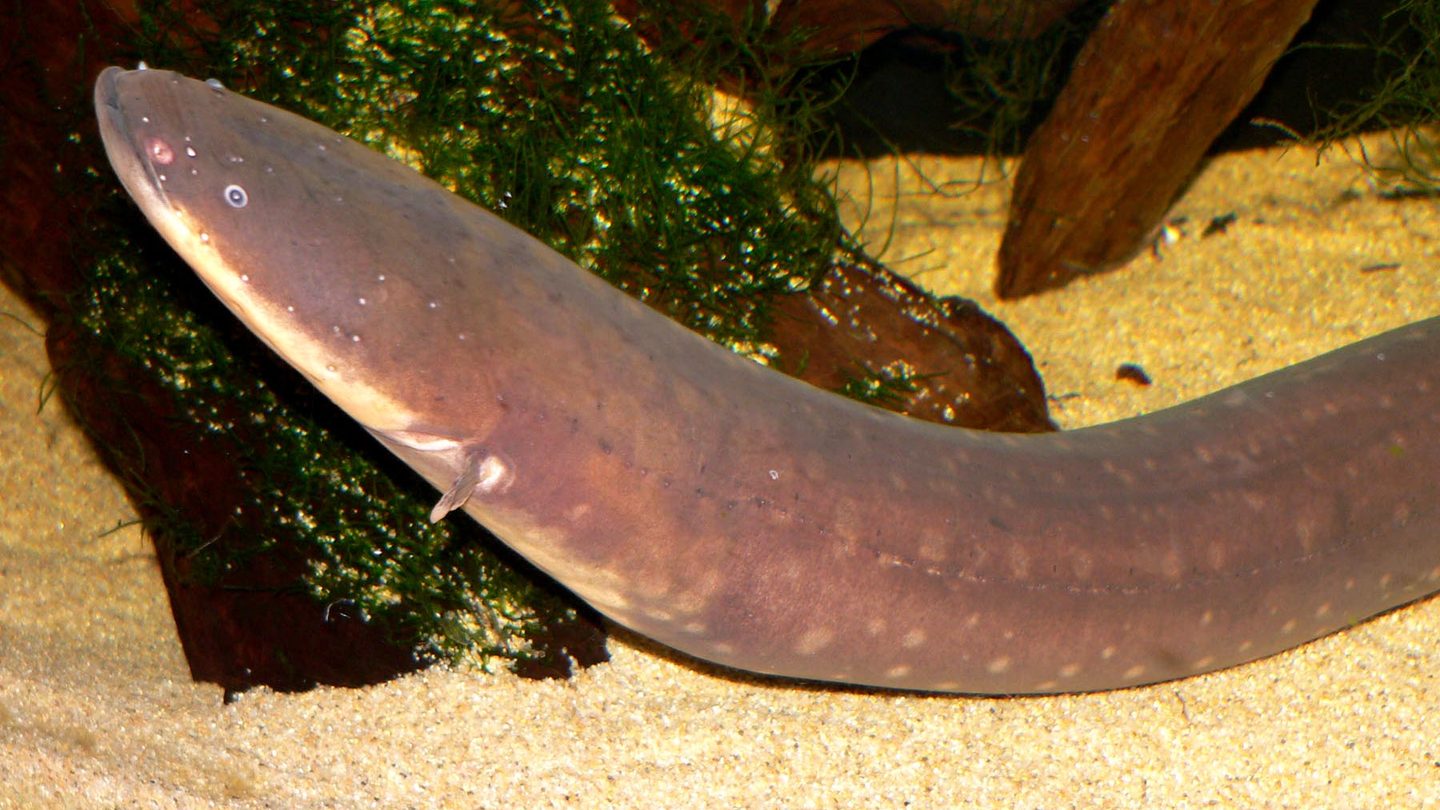
The taxonomic change also complicates older accounts. Before the split, the name E. electricus was widely used for electric eels that would now require closer identification. An aquarium photograph with an old species label is evidence of an electric eel's appearance, not proof that it shows the species with the measured voltage record. The photograph on this page is used in that limited sense.
The human-arm experiment measured a different quantity
Kenneth Catania's 2017 Current Biology experiment measured peak currents of 40 to 50 milliamps through a human arm during defensive leaps by a small electric eel. The study found strong pain confined to that limb, with no reported sensation of sustained involuntary muscle contraction. This controlled exposure was different from a swimmer's encounter; it was not a test of a lethal current through the heart.
As the eel rose from the water while contacting the arm, the electrical circuit directed current through the target and back toward the water. This answers a question raised in an actual Reddit discussion: how can a fish deliver a shock if electricity needs a completed circuit? The conducting water and the contacted body can form parts of that circuit. A person need not touch two visibly separate wires.
The result demonstrates painful current transfer. It does not establish a safe distance from a wild eel or a current threshold that separates survivable encounters from fatal ones.
Electricity reaches nerves without an injected toxin
Electric organs contain electrocytes, cells derived from muscle tissue that work together to generate a discharge. Strong volleys can activate the motor nerves controlling skeletal muscles, causing movement without the target choosing it. The clinical paper connects that mechanism to the loss of movement and muscle injury described in its cases.
That differs from the stinging apparatus described in the moon jellyfish article, where tiny capsules discharge tubules. The sea urchin guide explains another structure, the venom-delivering pincers of the flower urchin. Those pages describe separate mechanisms; neither offers a way to judge an electric eel's shock.
Electrical stimulation can interfere with muscle control without an animal first biting through skin or injecting venom. In water, the resulting inability to move has consequences beyond the sensation of pain.
The missing denominator
Two case descriptions cannot yield a death rate. The researchers did not sample a defined population of people shocked by eels, and one fatality in their report must not be turned into a claim that half of encounters are deadly. Their discussion explicitly says the available evidence cannot establish whether electric eels are a major public-health problem.
The supported answer is narrower: serious injury and a fatal drowning following an observed encounter have been clinically reported. The authors recommend consulting local communities about eel-inhabited waterways and identifying risky bathing areas. Their evidence gives no basis for deliberately testing a shock, or for promising that shallow water makes an encounter harmless.